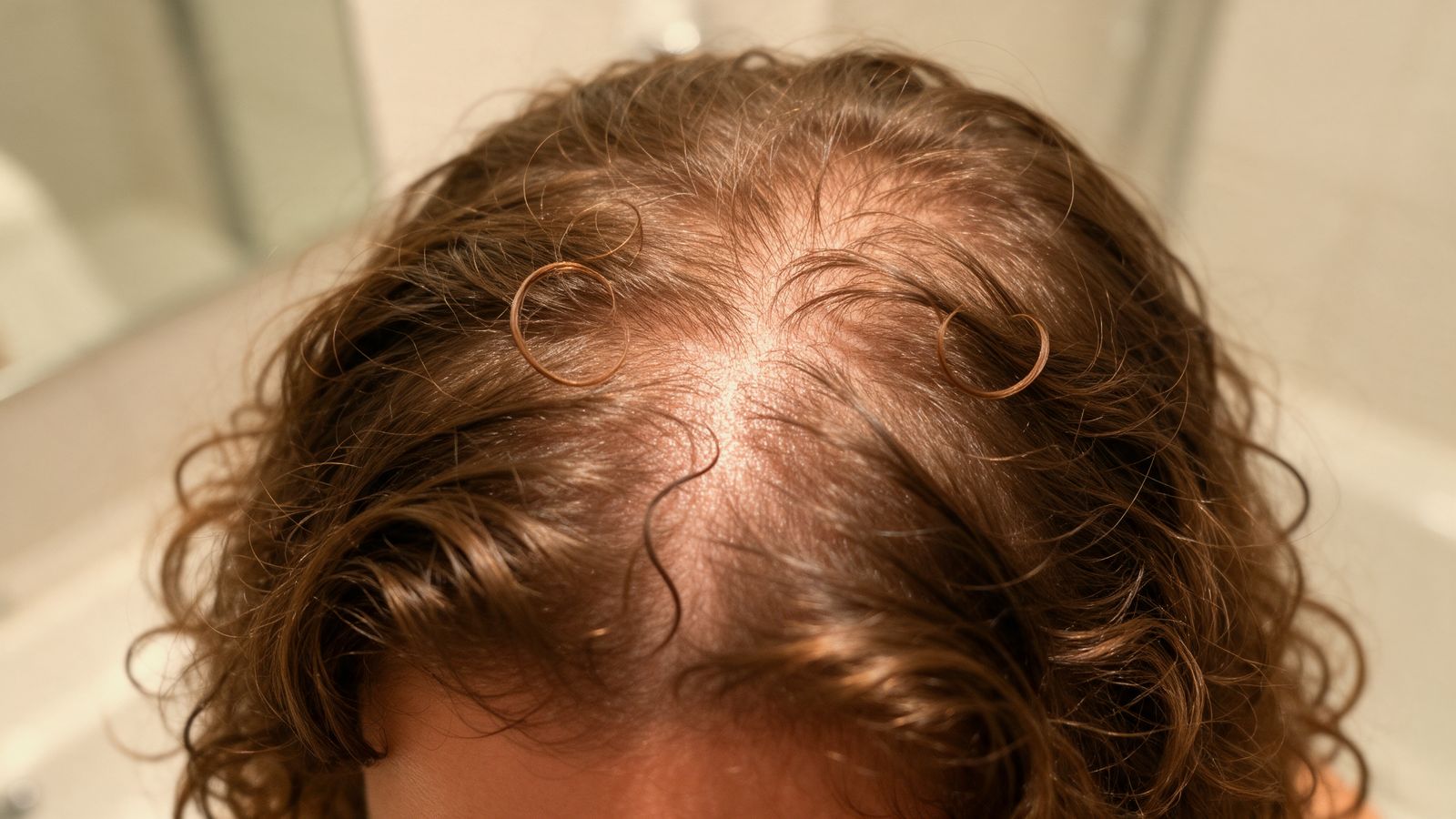
My story in short
I was put on the contraceptive pill at 16 because my periods hadn't settled. Nobody asked why they hadn't settled, only how to make them regular. I stayed on it for five years, and my naturally curly hair turned a dry, coppery orange that wasn't my colour and started to shed.
When I came off the pill at around 21, the shedding slowed after a few months and tiny new curls came through at my hairline. Then my skin broke out, my hormones were everywhere, and I didn't have a period for a whole year.
The second wave started at 26, and it was the frightening one. I was told I had endometriosis, yet my pain was manageable and my oestrogen came back "normal" on paper. So nobody connected it to my hair. By 29, at my worst, I wore a bun at the back every single day to hide how thin it had become. I felt ugly and embarrassed. I stopped swimming, stopped wearing my hair down, and avoided anything that meant a helmet or wet hair.
People noticed, even when they said nothing. Some told me to try oils. Some pretended not to see it. Others asked why my hair was always up. My GP told me it couldn't be the pill, that it couldn't be heavy metals or hormones because my results were in the normal range, and dismissed naturopathy entirely.
Then at 32, after I had my kids, my periods became much heavier. I couldn't swim around my period and needed medication to reduce the bleeding, and that coincided with anaemia. I believe that blood loss was linked to my hair loss too, which is why iron became such a big part of my recovery.
"With curls I hardly ever brush, so the shower drain told me first. I started washing less, just so I didn't have to see it."
It took years of trial and error to understand my root causes. Once I did, my hair grew back strong within about a year. I'm honest about where it is now further down, because I don't believe in miracle stories. You can read every note I kept in my diary.
Can endometriosis cause hair loss?
It can contribute. A 2021 review in The Lancet describes endometriosis as a chronic systemic disease that drives inflammation and affects metabolism well beyond the pelvis[1]. Hair follicles are sensitive to inflammation, hormone shifts and low iron, so shedding can be one of the ways that whole-body imbalance shows up.
Hair loss isn't on the usual list of endometriosis symptoms, which is exactly why it gets missed. These are the threads I eventually pulled together for my own body, with the research that helped me understand them:
- Inflammation. Endometriosis is no longer seen as "just" a pelvic condition. It is linked to whole-body inflammation[1], and chronic inflammation is hard on a healthy hair cycle.
- Oestrogen clearance through the gut. The gut microbiome helps regulate how much oestrogen circulates, through an enzyme called beta-glucuronidase[2]. For me, gut work and hormone work turned out to be the same job.
- Iron. Heavy or long periods can drain iron stores. Dermatologists have long linked low iron stores with hair shedding in women[3], and mine were low.
- Thyroid. Thyroid problems are a well-known cause of diffuse hair loss[5], and they often travel alongside hormonal conditions. I wrote a full guide to thyroid hair loss in women.
- Stress. In a 2021 study, chronic stress hormones kept hair follicle stem cells in a long resting phase[11]. The study was in mice, but it matched what I felt.
Why is my hair falling out when my blood tests are normal?
Because "normal" is a wide range, and a single hormone inside it says little about balance. Oestrogen and progesterone matter in relation to each other, on the right day of your cycle. Ferritin and a full thyroid panel are also often left off routine bloods unless you ask.
This was my hardest-won lesson. Even when I finally got a full hormone panel, each number was simply called "normal". Nobody looked at the ratio between my hormones, or when in my cycle the blood was drawn. My oestrogen was in range. The balance clearly wasn't, and my hair was the first place it showed.
Ferritin is a good example. A 2023 clinical guide suggests that in otherwise healthy people with hair loss, a ferritin of 40 micrograms per litre or lower can point to iron deficiency[4], which is higher than the cut-off many labs flag. A result can be "in range" and still worth a conversation.
The tests I asked for
A full thyroid panel, iron studies with ferritin, a cycle-timed sex-hormone panel read as ratios, a heavy-metal screen and a stool microbiome test. I also did a hair mineral test. Your practitioner decides what suits you.
The biggest change in my recovery was walking into appointments already knowing what to ask for. One honest warning: no GP ever suggested a natural approach to me. GPs can order the tests, but for the root-cause side I needed a functional-medicine practitioner or naturopath, and it took reading reviews and asking friends to find someone who listened.
| Test | Why I asked for it | What I found |
|---|---|---|
| Full thyroid panel | My GP had only ever checked TSH | A sluggish thyroid picture worth supporting |
| Iron studies + ferritin | Low iron is a common hidden driver of shedding[3] | Low ferritin |
| Sex hormones, cycle-timed | To read oestrogen and progesterone as a ratio | "Normal" numbers, unbalanced ratio |
| Heavy-metal screen | Not standard, I pushed for it | High arsenic, which surprised me |
| Stool microbiome test | The gut helps clear oestrogen[2] | Showed what my gut was missing |
| Hair tissue mineral analysis | Ordered online for under $100, no referral | A 30-page report about four weeks later |
Be careful with hair mineral tests. I found mine a useful starting point. A 2001 JAMA study sent the same hair sample to six commercial labs and got results that differed more than tenfold for some minerals[6]. Treat a hair test as a prompt for proper blood tests, not a diagnosis.
If you take biotin, say so before any blood test. The US FDA warns biotin can make some lab results falsely high or low, including thyroid tests[9].
What made my shedding worse
Chasing "hair growth" before I knew my root cause. Minoxidil gave thin regrowth that vanished when I stopped. Oestrogenic herbs, lots of soy, going vegan, holy basil and turmeric all made my shedding worse, and biotin did nothing for me.
- Minoxidil. I got some feathery new hairs, but they were thin and stunted, and they disappeared once I stopped. I knew I wanted to stay away from things that felt unnatural to me, so that was the push to find the real cause.
- Oestrogenic herbs and too much soy. Fo-Ti and Dong Quai made my hair shinier but spiked my oestrogen, and I gained weight. Swapping dairy for lots of soy milk and tofu cleared my skin, which fooled me, but I felt more tired and off balance.
- Going vegan. Even with omega supplements, my nails peeled, my hair got drier and the shedding sped up.
- Keto. It helped my insulin resistance but didn't suit my hormones.
- Holy basil. More shedding and an itchy scalp.
- Turmeric. My shedding increased. Early lab and animal research suggests curcumin can affect progesterone, though the direction varies and human evidence is thin. Separately, a 2024 study found lead contamination in 14% of turmeric samples tested across South Asian markets[10]. I stopped taking it.
- Biotin. It's in every hair supplement, and it did nothing for me. Reviews find little evidence it helps people who aren't deficient[8].
- Coconut oil on my scalp. No change at all.
- Spironolactone. I personally chose not to take it, because I wanted to address the cause rather than block hormones long term. If it's been prescribed to you, that's a conversation for you and your doctor.
What helped my hair grow back
Switching from "what grows hair?" to "what is throwing my body off?" For me that meant healing my gut, helping my body clear excess oestrogen, fixing low iron and minerals, gently supporting my thyroid, lowering stress, and a simple scalp routine, all alongside practitioners.
These are the things I used, roughly in order of impact. They are not prescriptions. Please work out your own with a qualified practitioner.
1. Healing and feeding my gut
I cut gluten and dairy, drank bone broth, did a gentle celery-juice phase, and took fibre and probiotics daily. Acacia fibre and inulin made the most difference for me, and I even watched my stool as a daily sign things were working. Too many nuts and seeds triggered gut pain, so I cut back on those too.
2. Helping my body clear excess oestrogen
This was central because of my endometriosis. I used DIM, removed phytoestrogens from my diet, and supported my liver with artichoke while avoiding milk thistle. Phytoestrogens are genuinely debated, so this is simply where I landed for my body.
3. Fixing iron, the faster way
Oral iron is slow. It took me more than three months to see any change in my hair. If your ferritin is low, ask your doctor whether an infusion or more red meat makes sense for you.
4. Minerals and nutrients
Zinc, magnesium, selenium, vitamin C, L-arginine, B vitamins, myo-inositol for the insulin side, and NAC, which I still take daily. I also tried metformin for a while, which is a prescription conversation for your doctor.
5. Supporting a sluggish thyroid, slowly
I very slowly increased iodine with Lugol's drops. Iodine is potent: the American Thyroid Association warns that many iodine supplements far exceed safe daily limits and can trigger thyroid problems[12]. Only do this with a practitioner and proper thyroid testing.
6. Lowering my toxic load
Chlorella and a high-concentration liquid zeolite. I also noticed lighter periods while taking these.
7. A gentle scalp routine
Regular scalp cleansing, castor-oil scalp washes, rosemary-oil blends and an apple-cider-vinegar rinse. A small 2015 trial found rosemary oil performed similarly to 2% minoxidil over six months with less itching[7], although it only included men. One warning for curls: in active shedding, don't drown your hair in heavy oil. Washing it out pulls hairs you can't spare.
8. Calming my nervous system
I swapped hard cardio for yoga and slow breathing, took Epsom-salt baths, and slowed my life down. I also used red-light therapy at home and had PRP in a clinic, which gave me noticeably healthier hair.
What does regrowth look like on curly hair?
For me it started as short, fuzzy baby hairs along my part and hairline, before the shedding had even slowed. On curly hair they stand up and frizz rather than lying flat, so they are easy to mistake for breakage at first.
I was hopeful when the fuzz appeared, but careful too. Minoxidil had given me fuzz once before, and it disappeared when I stopped. Some of the new baby hairs even fell out during later shedding phases, and that felt hopeless. I kept going because I wanted to wear my hair down again and hear someone compliment it. Over the years I spent thousands, buying everything that had data behind it. What finally worked was the root-cause work above, not another product.
My curly hair routine now
Leave-in conditioner, washing only once or twice a week, and a leave-in oil now and then. I take NAC, zinc and iron regularly. I eat whole foods, and I will never go back to soy or processed protein bars, even the soy-free ones.
Where my hair is now
My hair is full and healthy again, curls and all. I still shed more when I eat badly, when my hormones shift or when stress climbs. The difference is that I now know my triggers and what to do about them.
I won't pretend I'm cured. Some of us are simply more sensitive, and my hair is still the first place my body tells me something is off. What changed is that I'm no longer scared of it. I understand it. That feels like the real win: not perfection, but control.
If I could tell my 16-year-old self one thing on the day she was put on the pill, it would be "run". I would have seen a naturopath first if my parents had let me. If you're reading this at 2am with a shower drain full of curls, I wrote this for you. You can follow every step and setback in my diary.
Comparing what I tried
Topicals and treatments worked on the scalp, but only while I used them. The changes that lasted came from fixing what was underneath: iron, gut health, hormone balance and stress. Here is how the main options stacked up for me, with the research where it exists.
| Option | What I liked | What to know |
|---|---|---|
| Minoxidil | Visible fuzz within months | My regrowth was thin and disappeared when I stopped |
| Rosemary oil | Gentle, natural, less itchy | The main trial was small, used 2% minoxidil and only included men[7] |
| Oral iron | Cheap and easy to start | Slow: over three months before I saw change. Ask about ferritin, not just haemoglobin[3] |
| Biotin | In every hair supplement | Little evidence unless you are deficient[8], and it can skew thyroid tests[9] |
| Gut and oestrogen work | Changed my hair, skin and periods together | Takes months, and works best guided by a practitioner[2] |
| Stress reduction | Free, and I felt better within weeks | Research on stress and hair is strongest in animal studies so far[11] |
| Red light and PRP | PRP gave me noticeably healthier hair | Costs add up; ask a clinic about evidence and suitability |
When to see a doctor about hair loss
See a doctor if shedding lasts more than a few months, comes in sudden patches, or your scalp is sore, red or scaly. Go sooner if you also have very heavy periods, constant tiredness or other signs that something else is going on.
Book an appointment if you notice:
- Shedding that hasn't settled after about three months
- Round bald patches, or hair loss at the hairline or eyebrows
- A sore, red, scaly or itchy scalp
- Periods that soak through a pad or tampon within two hours, or last longer than seven days
- Tiredness, breathlessness, feeling cold or a racing heart, which can point to low iron or thyroid issues[5]
- Hair loss after starting or stopping a medication, including the pill
Take your questions in writing. It made a huge difference to me, because "normal" became the start of a conversation instead of the end of one.
My regrowth shelf
The kinds of things I used, and what I look for in each. Some links here are affiliate links: I may earn a small commission if you buy, at no extra cost to you.
Scalp oil
Rosemary-based blends that are light enough not to weigh curls down during shedding.
product coming soonCastor oil
Cold-pressed, hexane-free. I used it as a pre-wash scalp treatment, not left in.
product coming soonLeave-in conditioner
A curl-friendly leave-in so I could wash only once or twice a week.
product coming soonFibre
Acacia fibre and inulin, unflavoured, started at a small dose.
product coming soonIron
A gentle form your doctor is happy with, taken away from tea and coffee.
product coming soonRed-light device
A home LED cap or panel. Check the wavelength and look for published testing.
product coming soonAt-home hormone monitor
Urine-based trackers that measure LH, oestrogen (E3G) and progesterone (PdG) across your cycle, so you can see patterns between blood tests.
product coming soonThe bottom line
Endometriosis can show up in your hair long before anyone links the two, and "normal" blood tests don't always mean everything is fine. For me, regrowth came from asking for the right tests, fixing low iron, healing my gut, helping my body clear oestrogen and calming my stress, not from another bottle on the shelf.
If your hair is shedding and you have endometriosis or heavy periods, start with the tests in this guide and a practitioner who will look at the whole picture. And if you need someone who has been exactly where you are, my diary is open.
Questions women ask me
Can endometriosis cause hair loss?
It can contribute. Endometriosis is now described as a systemic inflammatory disease that affects the whole body, and inflammation, hormone imbalance and iron loss from heavy periods can all disrupt the hair cycle. Hair loss is not a listed core symptom, so the link is often missed. This is personal experience plus published research, not medical advice.
Why is my hair falling out when my blood tests are normal?
Reference ranges are wide, and a single hormone inside the range says little about the balance between hormones such as oestrogen and progesterone. Ferritin and a full thyroid panel are also often not run unless you ask. Ask your practitioner to time hormone tests to your cycle and read them together.
What tests should I ask for if I'm losing hair?
The tests Apple asked about were a full thyroid panel (not just TSH), iron studies with ferritin, a cycle-timed sex-hormone panel read as ratios, a heavy-metal screen and a stool microbiome test. Your practitioner decides what is right for you.
Does hair grow back after endometriosis or hormonal hair loss?
Apple's did, within about a year of working on root causes rather than chasing growth products. Shedding linked to a trigger often settles once the trigger is addressed, but results vary and a practitioner should confirm the cause.
Does biotin help hormonal hair loss?
Reviews find little evidence that biotin helps hair growth in people who are not deficient, and the FDA warns biotin can skew some lab results, including thyroid tests. Tell your doctor if you take it before any blood test.
What does hair regrowth look like on curly hair?
Usually short, fuzzy baby hairs along the part and hairline that stand up and frizz instead of lying flat. Apple saw them before her shedding slowed. Some can fall out again during shedding phases, so give it months, not weeks.
Can heavy periods cause hair loss?
They can contribute. Heavy bleeding drains iron, and low iron stores are linked with shedding in women. Apple's heavier periods after having children, at 32, coincided with anaemia and ongoing shedding. Ask your doctor to check ferritin, not just haemoglobin.
Is rosemary oil as good as minoxidil?
One small 2015 trial found rosemary oil performed similarly to 2% minoxidil over six months, with less scalp itch. It only included men, so it is a promising sign rather than proof for women.
Personal experience and general education only, not medical, nutritional or diagnostic advice. Results vary. Please talk to your own qualified practitioner before changing anything. "Apple" is a pen name.
Research sources
- Taylor HS, Kotlyar AM, Flores VA. Endometriosis is a chronic systemic disease: clinical challenges and novel innovations. The Lancet. 2021;397:839-852. Source
- Baker JM, Al-Nakkash L, Herbst-Kralovetz MM. Estrogen-gut microbiome axis: physiological and clinical implications. Maturitas. 2017;103:45-53. Source
- Trost LB, Bergfeld WF, Calogeras E. The diagnosis and treatment of iron deficiency and its potential relationship to hair loss. J Am Acad Dermatol. 2006;54(5):824-844. Source
- Serum ferritin levels: a clinical guide in patients with hair loss. Cutis. 2023. Source
- Impact of thyroid dysfunction on hair disorders. Cureus. 2023. Source
- Seidel S, et al. Assessment of commercial laboratories performing hair mineral analysis. JAMA. 2001;285(1):67-72. Source
- Panahi Y, et al. Rosemary oil vs minoxidil 2% for the treatment of androgenetic alopecia: a randomized comparative trial. Skinmed. 2015;13(1):15-21. Source
- Patel DP, Swink SM, Castelo-Soccio L. A review of the use of biotin for hair loss. Skin Appendage Disord. 2017;3(3):166-169. Source
- US FDA safety communication: biotin may interfere with lab tests (summary). Source
- Forsyth JE, et al. Evidence of turmeric adulteration with lead chromate across South Asia. Sci Total Environ. 2024;949:175003. Source
- Choi S, et al. Corticosterone inhibits GAS6 to govern hair follicle stem-cell quiescence. Nature. 2021;592:428-432. NIH summary. Source
- American Thyroid Association. Statement on the potential risks of excess iodine ingestion and exposure. Source