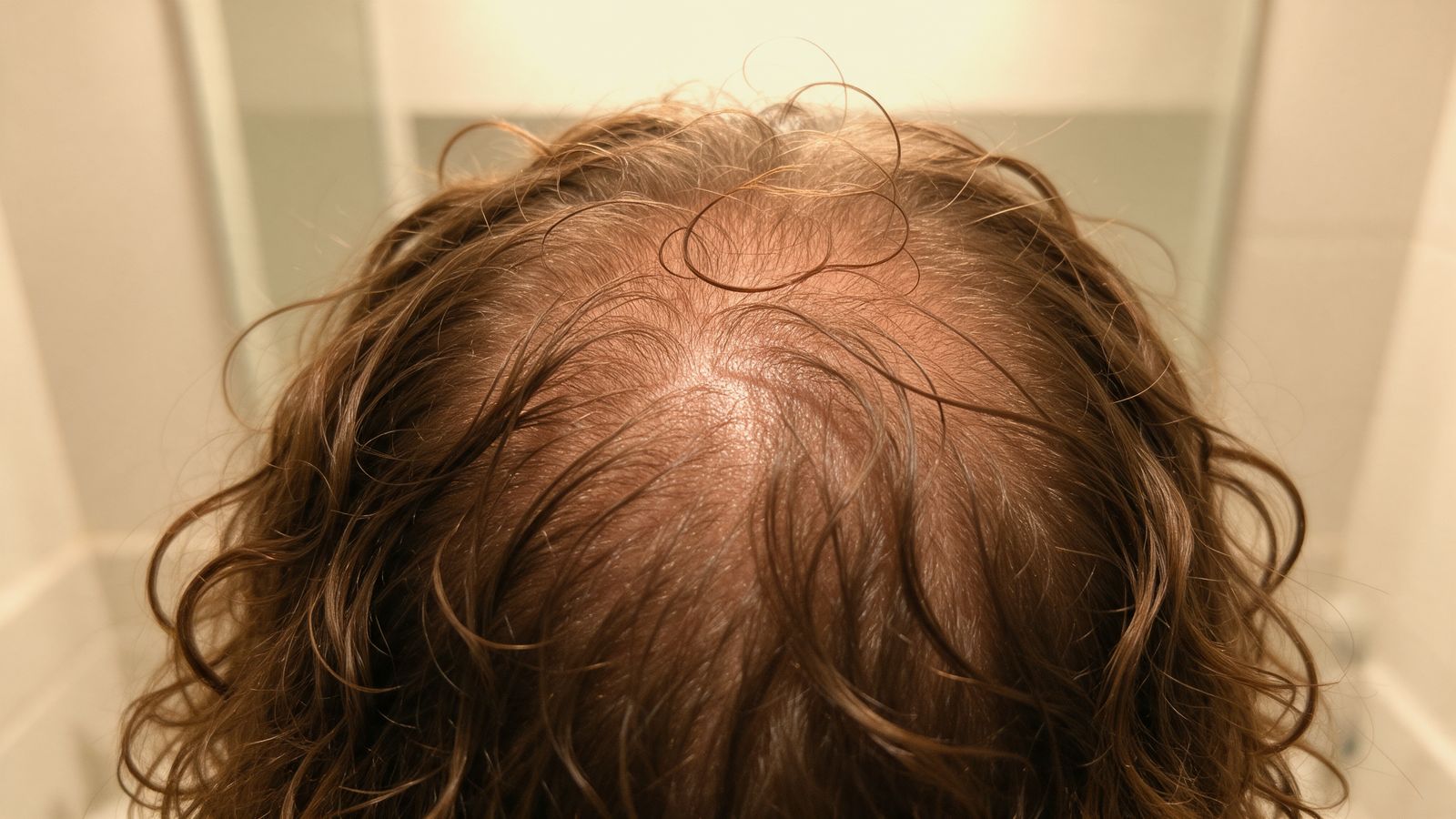
My bun years
By 29, at my worst, I wore a bun at the back of my head every single day. It was the only way I felt safe leaving the house. I didn't have to see my part, nobody could see my scalp, and I didn't have to think about it.
What I didn't know then was that the way I wore that bun mattered. On bad days I pulled it tight, because tight felt secure. Some days my scalp ached when I took it out. I was so focused on hiding the hair I was losing that I never thought about the strain I was putting on the hair I still had.
"I wore it up so nobody would see. I just wish someone had told me to wear it up loosely."
This guide is everything I wish I had known: how to hide thinning curly hair on the days you need to, without adding to the problem. It sits alongside the real work of finding your root cause, which you can read about in my story or start with the 2-minute self-check.
What are the best hairstyles for thinning hair?
Styles that lift the root, soften or move your part, and frame your face. On curly hair that means a zigzag or deep side part, face-framing curls, a loose pineapple, a loose half-up, and diffused volume at the crown. The common thread is low tension.
Thinning on curly hair usually shows first at the part and the crown, especially under harsh bathroom or office lighting. These are the styles that helped me most, roughly from least to most effort.
1. Move your part
Hair that has been parted in the same place for years often looks thinnest right there. Flipping my part to the other side, or using a deep side part, instantly made the line of scalp less obvious. A zigzag part, made by drawing the tail of a comb from side to side as you go back, is even better: it breaks up the straight line your eye goes to.
2. Lift the roots
On wash day, I'd lift my roots while my hair was still damp, either with a few root clips (flat duck-bill clips placed at the crown while it dries) or by gently shaking my roots with my fingers while diffusing upside down. Volume at the root means more hair sits over your scalp. Remove the clips once your hair is completely dry, so you don't leave dents or pull on the follicles.
3. Face-framing curls
Leaving a few curls loose around your face draws the eye down and away from the crown. If your hairdresser can add some shorter face-framing layers, they spring up beautifully on curly hair and look intentional, not like you're hiding something.
4. The loose half-up
This became my everyday style once I stopped wearing the tight bun. Gather the top section loosely, twist once, and hold it with a light claw clip. It covers the crown, keeps curls off your face, and spreads the hold across lots of hair instead of pulling one spot.
5. The loose pineapple (and the low bun, done gently)
The curly "pineapple", gathering curls loosely at the very top of your head with a soft scrunchie, adds height and hides a wide part. If you love a bun, keep it low and loose, use a soft scrunchie or spiral tie, and change its position each day. Dermatologists rate loose buns as low risk; it's tight, daily pulling that causes problems[3].
6. Headbands and scarves
A wide, soft headband or a silk scarf tied as a headband covers the front of the part on bad days, and it looks like a style choice, not a cover-up. Choose padded or fabric bands rather than plastic ones with teeth, which can rub and snag.
What is the best claw clip for thin hair?
Lightweight claw clips with smooth, rounded teeth, silk or satin scrunchies, and spiral coil ties. They hold without a tight squeeze. Avoid heavy metal clips, thin elastics with metal joins, and anything that tugs or leaves your scalp sore.
When you're shedding, every hair you keep matters. The wrong clip or tie can snag and break curls, or pull on the same follicles day after day. Here is what I look for now.
- Claw clips: lightweight, with a matte (non-slip) finish and smooth, rounded teeth. A medium clip is perfect for a loose half-up. If a clip feels heavy enough to slide down, it's too heavy.
- Scrunchies: silk or satin, with a soft hold. They glide over curls rather than gripping and snapping them.
- Spiral coil ties: they grip at a few points instead of squeezing all the way around, and slide out without pulling.
- U-shaped hair pins: for a low bun, a couple of U-pins hold it loosely without the tight wrapping an elastic needs.
- Snap clips: small matte snap clips, placed just beside your part, can hide a gap. Use them sparingly and never in the same spot every day.
Skip: thin elastics with a metal join, rubber bands, heavy decorative clips, and anything you have to wind tightly. The American Academy of Dermatology specifically warns about tightly pulled buns, ponytails and up-dos[1].
Can hairstyles make hair loss worse?
Yes. Repeatedly pulling on the same hair causes traction alopecia, a separate type of hair loss, usually at the hairline and temples. The risk rises the tighter the style and the longer you wear it. Caught early it can often recover, but long-term pulling can cause permanent loss[2].
This was the part that shocked me. When you already have hormonal or iron-related shedding, adding traction is like adding a second problem on top of the first. A 2018 review describes traction alopecia as entirely tied to how much and how long hair is pulled, and notes it can progress to permanent scarring if the pulling continues[2].
The American Academy of Dermatology lists the warning signs to watch for[1]:
- Pain or aching when your hair is pulled back, or relief when you take it down
- Stinging, itching or small bumps on your scalp where hair is pulled
- Crusts or flaking along the hairline
- Broken hairs or a receding line at your forehead and temples
If you notice any of these, loosen or change your style straight away, and mention it to your doctor or a dermatologist. A Johns Hopkins review of 19 studies also suggests rotating styles and giving your hair regular breaks rather than wearing the same tight style for months[3].
Do root powders and hair fibres work?
For hiding a visible scalp, yes. Tinted root powders and sprays colour the scalp so the gap between hairs is less obvious, and keratin fibres cling to existing hairs to make them look thicker. They sit on top and wash out, so they don't treat or damage follicles.
On the days I had photos or an event, a little tinted powder along my part made more difference than any hairstyle. Some tips that work for curls:
- Match your root, not your ends. Curly hair is often lighter at the ends. Match the colour at your scalp, and go a shade darker rather than lighter.
- Powder for the part, fibres for the crown. A small angled brush puts powder exactly along the part. Fibres are better for a wider area at the crown.
- Apply to dry hair, then set. Shake fibres over dry curls, pat gently, then mist lightly with hairspray. Avoid touching it afterwards.
- Patch test first, especially if your scalp is sensitive or itchy.
- Wash it out properly. On wash day, gently cleanse your scalp so product doesn't build up.
Concealers are a confidence tool, not a fix. I used them while I was working on my root causes, and I'm glad I did: feeling okay about leaving the house made the whole process less lonely.
Is air drying or blow drying better for thinning hair?
A 2011 study found a hair dryer used about 15 cm away and kept moving caused less damage than long natural drying, while high heat held close caused the most surface damage[4]. For curls, a diffuser on low to medium heat is a gentle middle ground.
I used to think air drying was always kindest. The study above surprised me: hair left wet for a long time showed a specific kind of internal damage that hair dried with a dryer at a distance didn't, while very high heat damaged the hair's surface[4]. It was a single lab study on hair samples, so take it as a guide rather than a rule.
What I do now:
- Squeeze out water with a soft cotton T-shirt or microfibre towel. No rubbing.
- Diffuse on low or medium heat, keeping the dryer moving and not pressing it hard against my scalp.
- Stop when my hair is mostly dry and let the last bit finish on its own.
- Skip straighteners and curling irons while I'm actively shedding. The AAD also recommends limiting heat styling to protect hair[5].
How to talk to your hairdresser about thinning hair
Tell them before they start. Ask for shape and lift at the crown, face-framing layers, and a cut that takes weight off so curls spring up. A good curly specialist will cut to make thinning less obvious, not just chop length.
I avoided the hairdresser for months because I was embarrassed. When I finally went, telling her straight away was such a relief. She had seen it many times before, and it changed how she cut my hair.
Things worth asking for:
- Layers that remove weight, so curls aren't dragged flat at the crown.
- Face-framing pieces to draw attention forward.
- A dry or curl-by-curl cut if your curls are very springy, so the shape is predictable.
- No tight sectioning or heavy pulling during the cut or styling. It's fine to say "please be gentle, my hair is shedding".
- A note on what she sees. Hairdressers often notice changes before we do, and can tell you if a patch looks different next visit.
Quick comparison
| Style or tool | What it hides | Pulling risk | Best for |
|---|---|---|---|
| Zigzag or side part | A wide or obvious part | None | Every day |
| Root lift while drying | Flat, see-through crown | Low (remove clips when dry) | Wash days |
| Loose half-up + claw clip | Crown and part | Low | Everyday wear |
| Loose pineapple | Wide part, flat top | Low if loose | Second-day curls |
| Tight bun or ponytail | Everything, for now | High if worn daily[3] | Avoid while shedding |
| Silk scarf or soft headband | Front of the part | None to low | Bad days, sleep |
| Root powder or fibres | Visible scalp | None | Photos and events |
Clips and tools I'd recommend
Some links here will be affiliate links: I may earn a small commission if you buy, at no extra cost to you.
Lightweight claw clip
Matte finish, smooth rounded teeth, light enough not to drag. Medium size for a loose half-up.
product coming soonSilk or satin scrunchies
Soft hold with less friction and snagging than standard elastics.
product coming soonSpiral coil hair ties
Grip without a tight squeeze, and they slide out without pulling curls.
product coming soonSilk headscarf
Covers a wide part on bad days and protects curls overnight.
product coming soonTinted root powder
Matched to your root colour, applied with a small brush along the part.
product coming soonKeratin hair fibres
Shake over dry hair at the crown, then mist with hairspray to set.
product coming soonThe bottom line
Hiding thinning hair is completely okay. It got me out of the house on days I didn't want to be seen. The key is to hide it gently: move your part, lift your roots, use light clips and soft ties, cover with a scarf or a little powder on bad days, and never pull tight.
Then do the real work alongside it. Find out what's behind your shedding, because that's what brought my curls back. Start with the self-check, then read my story.
Questions women ask me
What hairstyle hides thinning hair best on curly hair?
Styles that add volume at the root and break up the part hide thinning best: a zigzag or deep side part, face-framing curls, a loose half-up with a light claw clip, or a loose pineapple. Keep tension low so you don't add pulling to the shedding.
Are claw clips bad for thinning hair?
Not usually. A lightweight claw clip with smooth, rounded teeth spreads the hold across lots of hair, so it pulls less than a tight elastic. Avoid heavy metal clips and anything that tugs or leaves your scalp sore.
Can wearing a bun every day cause hair loss?
A tight bun worn every day can cause traction alopecia, hair loss from repeated pulling. Dermatologists say loose, low buns are lower risk. Rotate styles, keep it loose, and change your style if you feel pain, stinging or see broken hairs at your hairline.
Do hair fibres and root powders damage hair?
Keratin hair fibres and tinted root powders sit on top of the hair and scalp and wash out, so they don't damage follicles. Patch test first, apply to dry hair, and wash your scalp well on wash day so product doesn't build up.
Is air drying or blow drying better for fragile hair?
A 2011 study found a hair dryer held about 15 cm away and kept moving caused less damage than leaving hair to dry naturally for a long time, while high heat close up caused the most surface damage. For curls, a diffuser on low heat is a good middle ground.
Should I cut my hair short if it's thinning?
Not necessarily. Many curly women find a layered cut that takes weight off lets curls spring up and look fuller. Ask a curly-hair specialist for shape and volume at the crown rather than a big chop.
Personal experience and general education only, not medical, nutritional or diagnostic advice. Results vary. Please talk to your own qualified practitioner before changing anything. "Apple" is a pen name. If your scalp is painful, red, scaly or you have patches of hair loss, please see a doctor or dermatologist.
Sources
- American Academy of Dermatology. Hairstyles that can cause hair loss. Source
- Billero V, Miteva M. Traction alopecia: the root of the problem. Clin Cosmet Investig Dermatol. 2018;11:149-159. Source
- Haskin A, Aguh C. All hairstyles are not created equal: what the dermatologist needs to know about black hairstyling practices and the risk of traction alopecia. J Am Acad Dermatol. 2016. Johns Hopkins summary. Source
- Lee Y, et al. Hair shaft damage from heat and drying time of hair dryer. Ann Dermatol. 2011;23(4):455-462. Source
- American Academy of Dermatology. How to prevent hair damage (2020). Source