My thyroid story
When my second round of hair loss started at 26, my GP ran the usual bloods. My thyroid was "fine". What I didn't know then was that "fine" meant one number, TSH, and nothing else.
I had a lot of the signs I'd later learn to recognise. I was tired in a way sleep didn't fix. I felt the cold. My curls were dry and my shedding wasn't slowing down. When I finally asked for a fuller thyroid panel, the picture looked sluggish, even though it hadn't been flagged before.
I also had endometriosis, and I'd read that too much oestrogen could weigh on the thyroid. That set me down a long road of learning how my hormones, my iron and my thyroid all affected each other, and my hair. This guide is what I wish someone had handed me at 26.
"Everything was 'normal' on paper. My hair, my energy and my cold hands said otherwise."
Can thyroid problems cause hair loss in women?
Yes. Hair follicles are direct targets of thyroid hormones, which help keep hair in its growing phase[2]. When thyroid levels are too low or too high, more hairs can shift into resting and shedding. A 2023 review found hair loss in about a third of people with hypothyroidism[1].
For a long time, it wasn't clear whether thyroid hormones acted on hair directly or only through their effect on the rest of the body. A 2008 study answered that: researchers grew human scalp hair follicles from women in the lab and added thyroid hormones. The hormones helped hair-making cells grow, reduced cell death, and even boosted pigment[2]. In other words, your hair follicles are listening to your thyroid.
That's why both directions matter:
- Underactive thyroid (hypothyroidism): the most common thyroid cause of hair loss in women. Hair can become dry, coarse and brittle, and shed more.
- Overactive thyroid (hyperthyroidism): can cause fine, soft hair and diffuse shedding too. The 2023 review reported hair loss in about half of people with an overactive thyroid[1].
The same review also made a point I found validating: the authors felt the impact of thyroid disorders on hair is underestimated[1]. If you've felt brushed off, you're not imagining it.
What does thyroid hair loss look like?
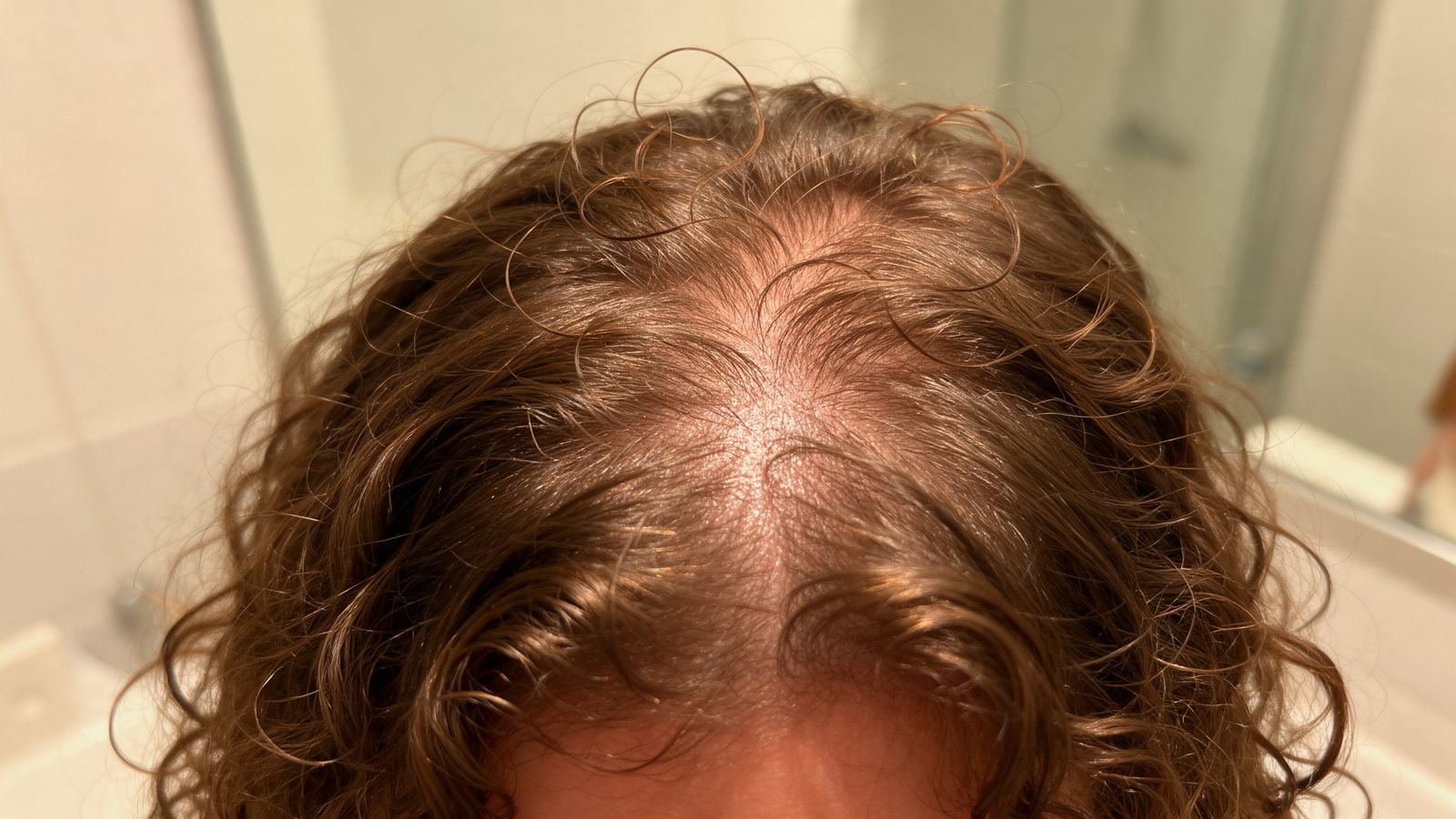
Usually diffuse thinning all over the scalp, not one bald patch. You may notice a wider part, more hair in the shower or your brush, and a change in texture: drier and coarser with an underactive thyroid, finer and softer with an overactive one.
On my curls, it looked like this:
- More hair in the shower drain. I barely brush my curls, so wash day was when I saw it all.
- A wider part under bathroom lighting, and less volume at the crown.
- Drier, frizzier curls that didn't hold their shape the way they used to.
- Slower regrowth, so the short new hairs I'd normally see along my hairline were missing.
Round, smooth bald patches are different. They're more typical of alopecia areata, an autoimmune condition that is also more common in people with autoimmune thyroid disease. That needs a doctor or dermatologist promptly.
What other signs point to a thyroid problem?
Look at the whole picture, not just your hair. An underactive thyroid often brings tiredness, feeling cold, weight gain and constipation. An overactive one often brings feeling hot, weight loss, a racing heart and anxiety. Write down everything you notice and take it to your appointment.
| Underactive thyroid (hypo) | Overactive thyroid (hyper) |
|---|---|
| Tired even after sleep | Restless, wired, trouble sleeping |
| Always cold | Always hot, sweaty |
| Weight gain without a clear reason | Weight loss without trying |
| Dry skin, brittle nails, dry coarse hair | Fine, soft hair |
| Constipation | More frequent bowel movements |
| Low mood, brain fog | Anxiety, irritability, racing heart |
| Heavier or irregular periods | Lighter or irregular periods |
You don't need every box ticked. I had maybe four from the left-hand column, and that was enough for me to push for proper testing. If you'd like a structured way to do this, the 2-minute self-check has a thyroid section.
Which thyroid tests should you ask for?
Ask for a full thyroid panel: TSH, free T4 and free T3, plus thyroid antibodies such as TPO if autoimmune thyroid disease is possible. Ask for ferritin at the same time. If you take biotin, tell your doctor and ask whether to pause it before the test[8].
This was the turning point for me. Here is what each test tells you, in plain English:
| Test | What it measures | Why it matters for hair |
|---|---|---|
| TSH | The signal from your brain asking the thyroid to work harder | The usual screening test, but on its own it can miss part of the picture |
| Free T4 | The main hormone your thyroid makes | Shows how much is actually available to your body |
| Free T3 | The active form your cells use | Helps show whether T4 is being converted well |
| TPO / thyroglobulin antibodies | Signs of autoimmune thyroid disease (Hashimoto's) | More common with endometriosis[4], and can appear before levels change |
| Ferritin | Your iron stores | Low iron is linked with shedding in women[5] |
Three things I wish I'd known before testing
- Biotin can skew your results. The US FDA warns biotin can make some lab results, including thyroid tests, falsely high or low[8]. It's in a lot of hair and nail supplements.
- Ask for the numbers, not just "normal". Keep a copy of every result so you can see trends over time, not just one snapshot.
- Test at a similar time of day each time, so results are easier to compare.
Endometriosis, oestrogen and your thyroid
They can be connected. Autoimmune thyroid disease appears to be more common in women with endometriosis[4], and oestrogen therapy can change how much thyroid hormone your body needs[3]. If you have endometriosis, take the pill or use HRT, and you're losing hair, a full thyroid panel is worth asking about.
This is the part of my story that took longest to piece together.
Hashimoto's and endometriosis
A 2024 study of women having fertility treatment found Hashimoto's thyroiditis in about 31% of women with endometriosis, compared with about 15% of women without it[4]. It was a small study, and the authors say more research is needed, but it matched what I'd suspected: my endometriosis and my thyroid weren't separate problems.
How oestrogen affects thyroid hormone
Oestrogen raises a protein in the blood that carries thyroid hormone around, called thyroxine-binding globulin. More of that protein can mean less free hormone available to your cells. In a well-known 2001 study, women with an underactive thyroid who started oestrogen therapy often needed a higher thyroid medication dose to stay balanced[3]. That study was in women on HRT, but it's one reason the pill and other oestrogen medicines are worth mentioning to your doctor when you talk about your thyroid.
I'd read that too much oestrogen could weigh on the thyroid, and this was the closest research I found to explain it. It's a big part of why I focused on helping my body clear excess oestrogen, which you can read about in my endometriosis story.
Why check thyroid and iron together?
Because they often travel together, and both can cause shedding. Low iron stores are linked with hair loss in women[5], and a ferritin of 40 micrograms per litre or lower may point to deficiency in people with hair loss[6]. An underactive thyroid can also bring heavier periods, which drain iron further.
For me, this was a double hit. My ferritin was low, my periods got much heavier after my kids at 32, and my thyroid was sluggish. Fixing one without the other would only have got me halfway.
If you only remember one thing from this guide, make it this: ask for ferritin every time you ask for thyroid tests. They're one blood draw.
Should you take iodine for thyroid hair loss?
Only with testing and a practitioner. Iodine is potent. The American Thyroid Association warns that many iodine and kelp supplements contain far more than the safe daily limit and can trigger thyroid problems, especially in people who already have thyroid disease[7].
I'm being honest about this one because I did use iodine. I very slowly increased Lugol's drops, alongside a practitioner and proper thyroid testing, and it helped my sluggish picture. But it's not something I'd ever suggest anyone try on their own. Too much iodine can push the thyroid the wrong way, and if you have Hashimoto's it can make things worse[7].
Please don't: start kelp, iodine drops or "thyroid support" supplements without knowing your thyroid levels and antibodies first, and without someone qualified watching your results.
Does hair grow back after thyroid treatment?
For many women, yes. Hair often starts to recover a few months after thyroid levels are back in a healthy range, but full regrowth can take six to twelve months. Some people notice extra shedding when treatment starts. Don't change your dose on your own; talk to your doctor if shedding continues.
Hair is slow. Because shedding lags its cause by a couple of months, it can feel like nothing is working long after your levels have improved. That's normal, and it's the hardest part.
What helped me stay patient was tracking. I took photos of my part under the same bathroom light every four weeks and kept a simple log of my wash-day shed. My first sign of progress was short, fuzzy baby hairs along my part, and they came before the shedding visibly slowed. If shedding continues well after your levels are stable, ask your doctor to look again at iron, other hormones and anything else in the picture.
What helped my thyroid and my hair
Getting the full picture first: a full thyroid panel, antibodies and ferritin. Then working on the whole system with a practitioner: iron, gut health, helping my body clear excess oestrogen, careful thyroid support, and lowering stress. It's what I did, not a prescription.
| What I did | Why | My caution |
|---|---|---|
| Asked for a full thyroid panel + antibodies | TSH alone hadn't shown my picture | Stop or declare biotin before testing[8] |
| Fixed low ferritin | Iron and thyroid were both dragging my hair down[5] | Oral iron took me 3+ months |
| Supported oestrogen clearance | Oestrogen can change thyroid hormone needs[3] | Do this with a practitioner |
| Very slow, monitored iodine | My thyroid picture was sluggish | Never without testing[7] |
| Selenium, zinc and whole foods | Part of my wider mineral rebuild | Ask about doses and interactions |
| Less hard cardio, more rest | Stress was making everything worse | Free, and I felt it in weeks |
The full root-cause story, including what made my hair worse, is in Endometriosis and hair loss.
When to see a doctor
Book an appointment if you notice:
- Hair loss along with tiredness, feeling cold or hot, or unexplained weight change
- A lump or swelling in your neck, or trouble swallowing
- A racing or irregular heartbeat, shaking or anxiety that's new for you
- Round bald patches, or a sore, red or scaly scalp
- Shedding that hasn't settled after about three months
- Very heavy periods, or periods lasting more than seven days
Take your symptom list and your questions in writing. It turned my appointments from "your bloods are fine" into a real conversation.
The bottom line
Your thyroid is one of the most common, and most overlooked, reasons for hair loss in women. Your hair follicles respond directly to thyroid hormones, so when your thyroid is off, your hair often tells you first. Ask for a full panel, check your iron at the same time, mention the pill or HRT and any endometriosis, and be wary of iodine and biotin.
And be patient with your hair. Mine took months to show it was coming back, but it did. If you're not sure where your shedding is coming from, start with the 2-minute self-check.
Questions women ask me
Can thyroid problems cause hair loss in women?
Yes. Both an underactive and an overactive thyroid can cause diffuse hair loss. A 2023 review reported hair loss in about a third of people with hypothyroidism and about half with hyperthyroidism. Hair follicles respond directly to thyroid hormones, so when levels are off, the hair cycle can be too.
What does thyroid hair loss look like?
Usually diffuse thinning all over the scalp rather than one bald patch. With an underactive thyroid, hair often becomes dry, coarse and brittle. With an overactive thyroid, it can become fine and soft. Patchy, round bald spots are more likely alopecia areata, which is also more common in people with autoimmune thyroid disease.
Which thyroid tests should I ask for if my hair is falling out?
Ask about a full thyroid panel: TSH, free T4 and free T3, plus thyroid antibodies such as TPO if autoimmune thyroid disease is possible. Ask for ferritin at the same time, and stop or declare biotin before testing, because it can skew thyroid results.
Does hair grow back after thyroid treatment?
For many people, yes. Hair often starts to recover a few months after thyroid levels are back in a healthy range, but it can take six to twelve months, and some people shed for a while when treatment starts. Don't change your dose on your own; talk to your doctor if shedding continues.
Is thyroid hair loss linked to endometriosis?
There may be a link. A 2024 study of infertile women found Hashimoto's thyroiditis in about 31% of those with endometriosis, compared with about 15% of those without. It was a small study, but it's a good reason to ask for a full thyroid panel if you have endometriosis and hair loss.
Should I take iodine for thyroid hair loss?
Not without testing and a practitioner. Iodine is potent, and the American Thyroid Association warns that many iodine and kelp supplements contain far more than safe daily limits, which can trigger thyroid problems.
Personal experience and general education only, not medical, nutritional or diagnostic advice. Results vary. Please talk to your own qualified practitioner before changing anything. "Apple" is a pen name.
Sources
- Impact of thyroid dysfunction on hair disorders. Cureus. 2023. Source
- van Beek N, et al. Thyroid hormones directly alter human hair follicle functions: anagen prolongation and stimulation of both hair matrix keratinocyte proliferation and hair pigmentation. J Clin Endocrinol Metab. 2008;93(11):4381-4388. Source
- Arafah BM. Increased need for thyroxine in women with hypothyroidism during estrogen therapy. N Engl J Med. 2001;344(23):1743-1749. Source
- Korošec S, et al. Coexistence of endometriosis and thyroid autoimmunity. Gynecol Obstet Invest. 2024;89(5):413. Source
- Trost LB, Bergfeld WF, Calogeras E. The diagnosis and treatment of iron deficiency and its potential relationship to hair loss. J Am Acad Dermatol. 2006;54(5):824-844. Source
- Serum ferritin levels: a clinical guide in patients with hair loss. Cutis. 2023. Source
- American Thyroid Association. Statement on the potential risks of excess iodine ingestion and exposure. Source
- US FDA safety communication: biotin may interfere with lab tests (summary). Source